Something I’ve discovered about movies is that they can take you to very different emotional places, and the most memorable ones are those that are most moving. Whether I’m laughing or crying, I fall in love when it touches someplace inside me and makes an impact.
Grave of the Fireflies, by Japanese animator Isao Takahata, struck a poignant chord in my heart because it explores both the simple elements of childhood, and the dark, and unimaginably horrific experiences that we hope to never live through ourselves. This film came out in 1988 and is based on the semi-autobiographical novel by Akiyuki Nosaka, who created the story as an apology to his own sister, who died in wartime Japan due to malnutrition.
Set in Japan during late WWII, Grave of the Fireflies follows the struggles of a small family after their hometown is firebombed. Seita and Setsuko are orphaned siblings who are sent to live with their distant aunt after their mother perishes in the air raids.

Seita is the brother who labors to shield his younger sister, Setsuko, from the harsh realities of the war, and keeps her hopes up with tireless devotion, comforting distractions, and a cherished tin of fruit candies. The children are treated with cruel indifference and stinging judgment from their aunt, who blames the children for failing to contribute to the war effort or work for a living, despite their youth.
Feeling that they are treated unjustly, Seita decides to leave the shelter of their aunt’s home and survive independently in a deserted bomb shelter in the nearby countryside. This part of the film is the most touching, as Seita strives to provide for his baby sister and prove that he can fend for them both. The scenes where the children cook and play house are very idealistic and serene. You become attached to these characters, and their plights and hardships become your own. One night the children capture tons of small blinking fireflies in their makeshift home, and try to preserve the hopeful lights in their empty candy tin. Their innoc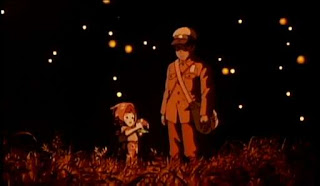 ence and naivety makes it harder to watch them endure what children should never have to endure.
Ill equipped and too proud to return to his aunt and ask forgiveness, Seita steals food from the nearby villages and fields as the bombs fall, but vainly scrounges for the necessities of life that are futile in securing their survival. Setsuko falls ill and Seita’s attempts to revive her fail. In the end both children meet their end, which is symbolic of the fireflies that they catch, which flicker brightly but eventually extinguish.
This film is tragic and moving, but also contains element of childish hopes and innocence. The painful journey that Seita and Setsuko make reveals the longing of all children, to be loved and taken care of, and to have someone there watching over them. Even in the face of hardship their love for each other is apparent to the end, even as Setsuko lies malnourished on her small bed, making cakes out of dirt for her brother, and asking him not to leave her side. These raw emotions are ver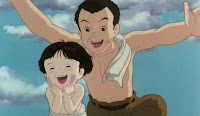 y relatable, to want to be near those that are dearest to us and take care of them, even when we have limited knowledge and resources.
This movie made me cry, but also made me smile. It is one that I will never forget, and I believe that Takahata has truly created a film that evokes painful truths about war and the loss of family and innocence. It is both intensely sad and overwhelmingly beautiful in its honest storytelling and brilliant animation.

Seita is the brother who labors to shield his younger sister, Setsuko, from the harsh realities of the war, and keeps her hopes up with tireless devotion, comforting distractions, and a cherished tin of fruit candies. The children are treated with cruel indifference and stinging judgment from their aunt, who blames the children for failing to contribute to the war effort or work for a living, despite their youth.
Feeling that they are treated unjustly, Seita decides to leave the shelter of their aunt’s home and survive independently in a deserted bomb shelter in the nearby countryside. This part of the film is the most touching, as Seita strives to provide for his baby sister and prove that he can fend for them both. The scenes where the children cook and play house are very idealistic and serene. You become attached to these characters, and their plights and hardships become your own. One night the children capture tons of small blinking fireflies in their makeshift home, and try to preserve the hopeful lights in their empty candy tin. Their innoc
 ence and naivety makes it harder to watch them endure what children should never have to endure.
Ill equipped and too proud to return to his aunt and ask forgiveness, Seita steals food from the nearby villages and fields as the bombs fall, but vainly scrounges for the necessities of life that are futile in securing their survival. Setsuko falls ill and Seita’s attempts to revive her fail. In the end both children meet their end, which is symbolic of the fireflies that they catch, which flicker brightly but eventually extinguish.
This film is tragic and moving, but also contains element of childish hopes and innocence. The painful journey that Seita and Setsuko make reveals the longing of all children, to be loved and taken care of, and to have someone there watching over them. Even in the face of hardship their love for each other is apparent to the end, even as Setsuko lies malnourished on her small bed, making cakes out of dirt for her brother, and asking him not to leave her side. These raw emotions are ver
 y relatable, to want to be near those that are dearest to us and take care of them, even when we have limited knowledge and resources.
This movie made me cry, but also made me smile. It is one that I will never forget, and I believe that Takahata has truly created a film that evokes painful truths about war and the loss of family and innocence. It is both intensely sad and overwhelmingly beautiful in its honest storytelling and brilliant animation.


 Chiriri (my personal favourite) is the summer fairy with long blonde, sailor moon-length reminiscent pig tails. She always wears a cute little handkerchief/hat on her head and likes to adapt many different objects into headwear. She has a surreal imagination, which usually resembles a soap opera, and tends to be very lady-like.
 With each episode only 12 minutes long its also ideal to finish in one night. I highly recommend it if you have some spare time, a fetish for childlike sentimentality and if you still like to believe in tiny fairies.
 Posts
Posts